It was a little under a year ago that Bungie showed off Marathon proper and told us all it was coming out in September, only for everyone who had a chance to play it essentially say “ruh roh Raggy,” leading to an indefinite delay. And here we are now! Within spitting distance of the shooter launching, a server slam that felt like being stuck in an Nvidia graphics card behind us, and now a word straight from the mouths of its developers about what seasons will be like.
Pokémon FireRed & LeafGreen is a difficult game to evaluate. Re-released on the Nintendo Switch eShop to celebrate Pokémon’s 30th anniversary, this 22-year-old Game Boy Advance remake of the original Pokémon Red & Blue feels like a lacklustre way to celebrate one of the largest media franchises known to man. On the other hand, I’m just happy to have a more convenient way to experience this nostalgic romp through Kanto again, catching personal favourites like Cubone along the way.
Making matters more difficult, FireRed & LeafGreen come as a separate purchase — $19.99 USD / £16.99 — rather than part of the GBA Nintendo Classics emulator which adds suspend saves and filters to many classic titles which are ‘free’ for NSO Expansion Pack subscribers.
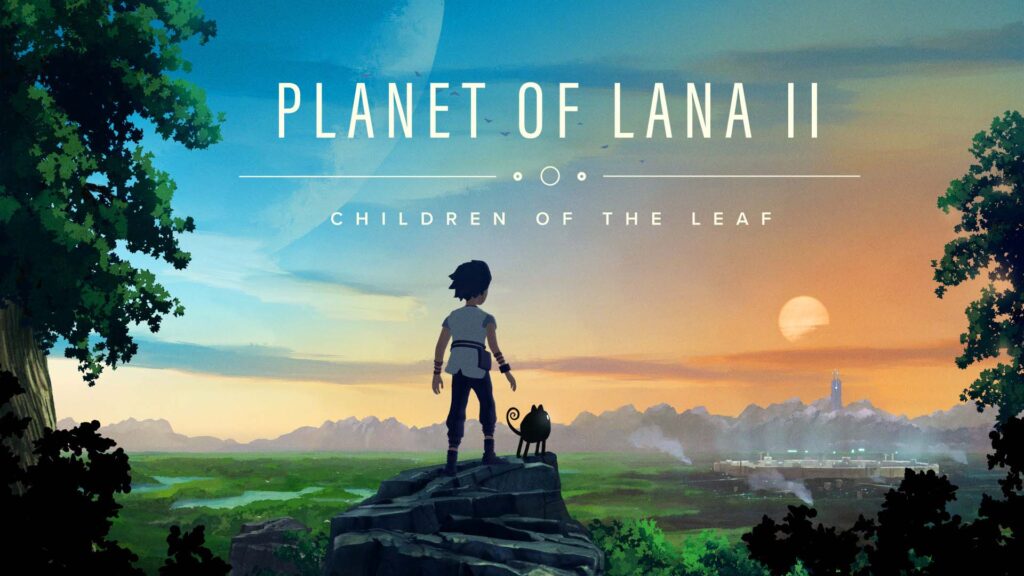
From Sketch to Puzzle: Crafting Planet of Lana II’s Clever Challenges
Dan Faxe, Lead Game Designer and Christian Enfors, Senior Game Designer
Summary
Planet of Lana II’s designers set out to expand on the first game’s beautiful world with new ways to interact with it and more interesting puzzles.
By way of example, learn the process of how they designed one particular puzzle from initial sketch through playtesting and refinement.
Planet of Lana II: Children of the Leaf launches March 5 on Xbox Series S|X, Xbox on PC, and Xbox One, with Xbox Play Anywhere and available day one on Game Pass Ultimate.
Warning: This article contains spoilers for one puzzle from the game!
When we began the game design process for this sequel, we had a clear goal in mind: Create deeper and more elaborate mechanics and puzzles, while at the same time maintaining the flow and accessibility of the first game.
To achieve this goal, we knew we wanted to give the player more control, and expand on Mui’s special hypnotize ability from the first game.
Using the environment as part of the challenge
In the first game, animals were controlled indirectly, by essentially constraining their position to Mui’s. In this sequel, we wanted the player to instead become the animal, controlling it freely in the world independent of Mui, and let the player experiment with its different movements and abilities.
This unleashed a whole new level of creativity and variation in the gameplay, where we could build puzzles around these new and fun animals that were lurking around in the world of Novo. One example is the tiny ink fish. Its fast and snappy movement lets it quickly navigate through the water, go through narrow tunnels, and it can even jump out of the water to reach new areas! Its special ability is that it can create an ink cloud, in which both the ink fish itself as well as Lana can hide from lurking dangers underwater.
Speaking of being under water, this is another aspect that we are introducing in this sequel. Lana can now dive down under the surface, which unlocks a whole new dimension of verticality to the puzzle design, as well as tension, because of the need to breathe.
Mui still has her fear of water, as in the first game, but now there’s a special kind of bubble plant that grows underwater in some places on Novo that Lana can fetch and tie to herself. Mui can then get inside of the bubble and together they can dive down and solve underwater puzzles!
When creating a puzzle, we always start with one or more overview sketches that we present to the rest of the team. We walk through it in stages, imagining how it would be to play and asking questions. Is the goal for the player clear enough? If failing, will the player get the feedback they need in order to not get stuck? Do we present the elements of the puzzle in the right order?
Balancing between challenge and flow
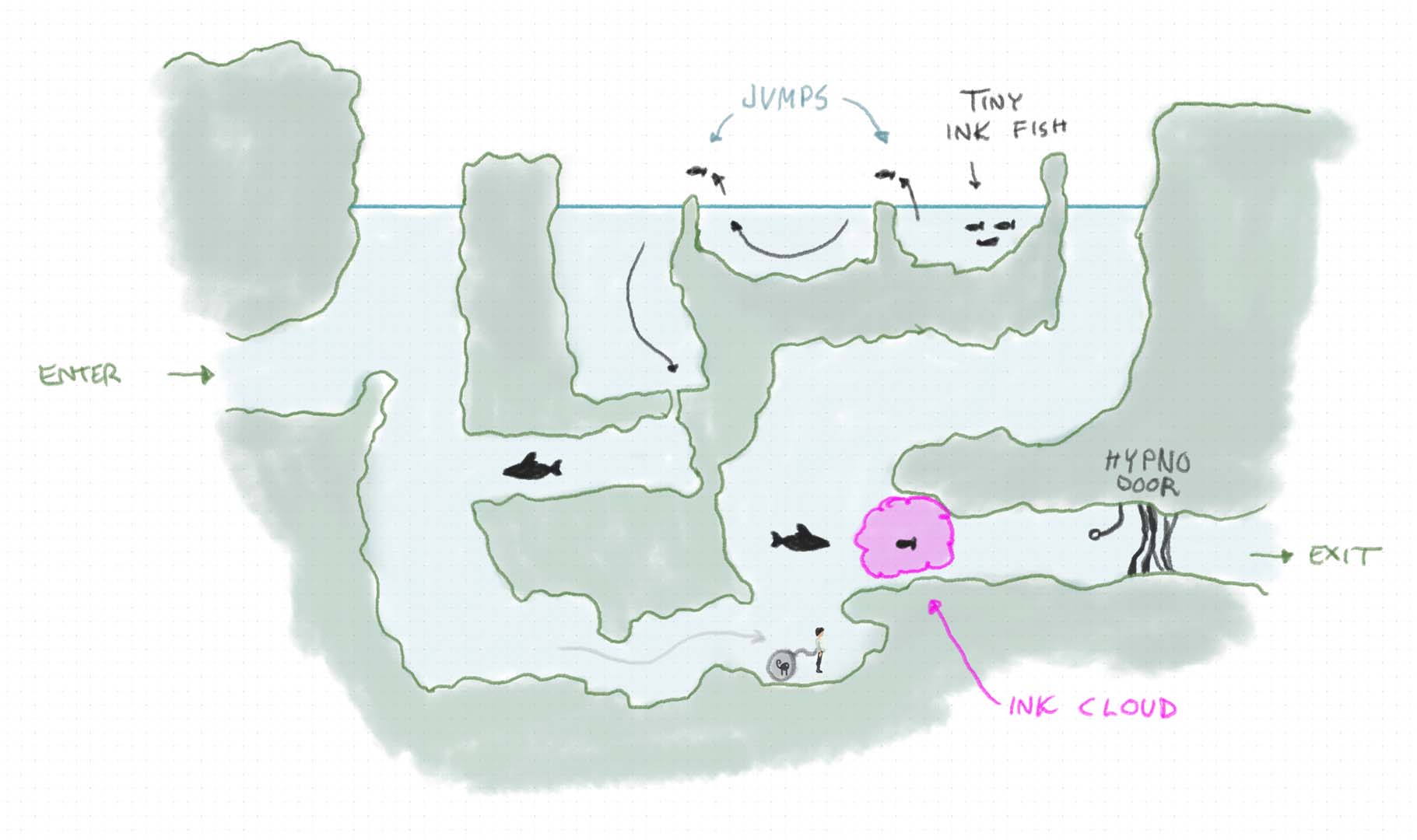
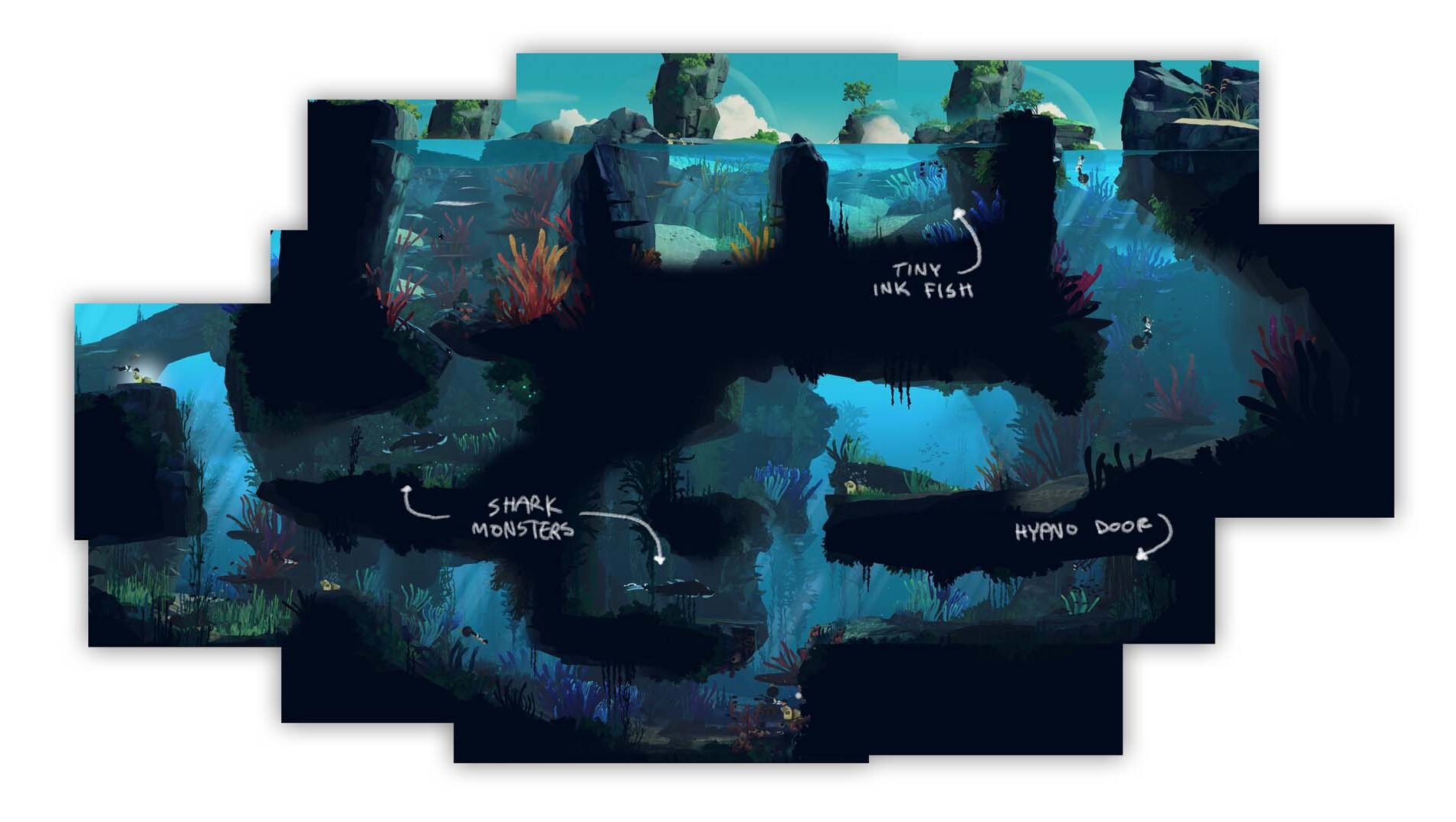
Here you can see a sketch of a puzzle where Lana has found one of the bubble plants mentioned earlier, and needs to find a way to open the underwater hypno door with Mui, without being seen by the shark monsters.
At this stage, we collect valuable feedback based on the sketches, make adjustments and present it again. We repeat this process until we are certain that we are on the right track.
Then the Level Designers make a first pass building it in the engine, making sure everything can be built with the art assets we have available. Also, adjustments are made here to ensure that distances and scale feel good while moving through it in-engine.
As soon as possible, we then try to playtest it on players who have not seen the puzzle sketches. It’s important that this happens in context with the rest of the game, since sometimes a puzzle builds on elements introduced earlier, so testing it in isolation could lead to it being much more difficult than intended if too many totally new puzzle elements are introduced at the same time.
When analyzing the playtests, we look extra carefully for player confusion and frustration, to make sure we don’t break the flow of the game. Having the player not immediately progressing is not always a problem, as long as the player is having fun and is coming up with new ideas of how to solve a puzzle. It can sometimes be a fine line between a fun challenge and a frustrating experience!
As can be seen from this overview from the final game, this particular puzzle mainly kept its shape from the sketch, apart from some tweaks in proportions and distances.
Another small difference is the extra tunnels added around the second shark monster, which were added because it made it feel more natural for players where they were supposed to place an ink cloud (at the tunnel intersection).
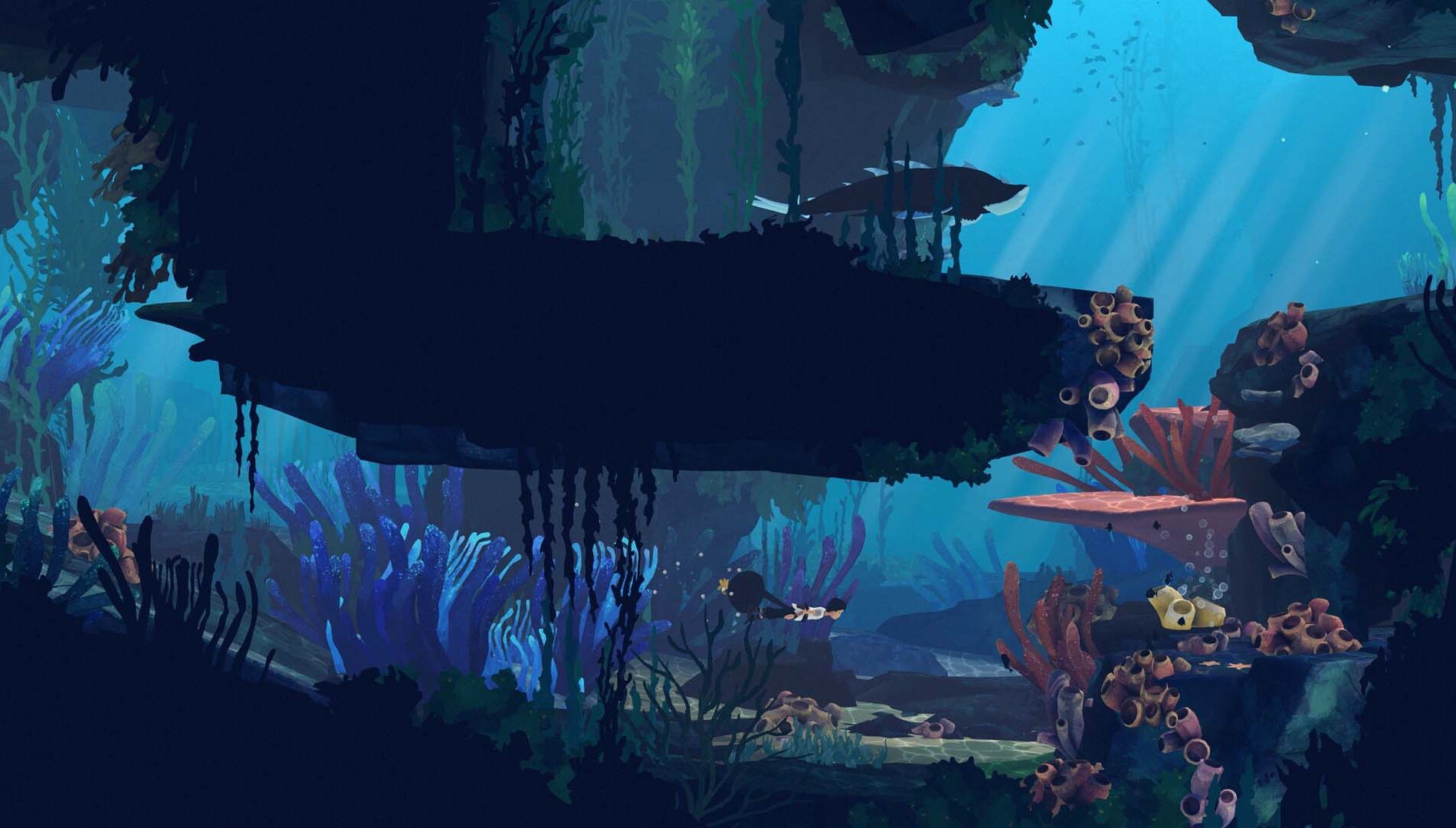
Once we see that a puzzle tests well, the Level Artists continue filling out the world with more visual details and lighting, making it more and more beautiful with each pass of polish, as can be seen in this screenshot from the same area of the game.
Thank you for the opportunity to give you a glimpse of what goes into making a puzzle. We really look forward to seeing players explore these new and exciting parts of Novo!
Planet of Lana II: Children of the Leaf will be released on March 5 and will be available with Xbox Game Pass Ultimate from day one! Wishlist now and go play Lana and Mui’s first adventure in the wait up to their epic continued journey, and follow @PlanetOfLana on social media to stay up to date.
A World After the Machines Came
On Lana and Mui’s home planet, new technology brings progress but also stirs greed and imbalance. As different tribes adopt it in their own ways, tensions grow and the world’s harmony begins to shift. When those seeking power push too far, Lana and her little companion are pulled into a journey that reveals long-buried truths about their planet and about themselves.
A World That Tells Its Story
Journey across frozen peaks, deep oceans, and forgotten ruins in a hand-painted world where nature meets technology. With no spoken dialogue, characters express themselves through an alien language, letting the world, music, and your choices carry the story and inviting you to find its meaning for yourself.
A Bond at the Center of the Journey
Planet of Lana II is a cinematic puzzle-adventure built around companionship and trust. Guide an older, more agile Lana and her loyal companion Mui as their bond becomes the key to moving forward in a world where beauty and danger live side by side.
Thoughtful Puzzles & Fluid Movement
Puzzles are woven naturally into the world, rewarding awareness, timing, and cooperation instead of complex logic. Turn Lana’s expanded agility, from wall jumps to smooth movement and momentum, into your path through danger.
An Emotional, Carefully Paced Adventure
As Lana and Mui travel, new discoveries unravel the history of their planet and the truth behind Mui’s origins. Their journey grows into an intimate tale of coexistence, responsibility, and the cost of progress, carried forward by a moving orchestral score that gives weight to quiet moments, bold discoveries, and every emotional turn across its 6 to 8 hour adventure.
A Standalone Experience
Planet of Lana II welcomes new players while offering a deeper journey for those returning, an intimate story about connection, resilience, and protecting what still matters in a changing world.
Key Features
A Cinematic Puzzle-Platformer Adventure
A story-driven experience blending exploration, environmental puzzles and cinematic atmosphere.
A Companion-Driven Journey
A heartfelt adventure built around the bond between Lana and her loyal companion, Mui.
A Hand-Painted World in Transition
Explore a beautifully crafted planet where nature and technology collide, and different tribes respond to progress in their own ways.
Fluid Exploration & Movement
Guide an older, more agile Lana with wall jumps, smooth traversal, and dynamic movement across diverse environments.
Thoughtful & Varied Puzzles
Puzzles are woven naturally into the world, focusing on observation, timing, and cooperation rather than complex logic.
Storytelling Without Words
No spoken dialogue. Meaning emerges through visuals, music, and your interactions with the world.
An Emotional, Carefully Paced Sci-Fi Tale
Uncover new truths about the planet and Mui’s past in a 6-8 hour cinematic journey, accompanied by a moving orchestral score.
Hey Troopers! We’re the team at Auroch Digital, and alongside our partners at Dotemu we’re currently Doing Our Part, by creating the most realistic depiction of war ever made. Starship Troopers: Ultimate Bug War is releasing on PlayStation 5 on March 16 – officially endorsed by FedDev – and we also have a world first for Starship Troopers fans.
For the first time ever, Starship Troopers: Ultimate Bug War will let you play as the enemy – the Arachnid Menace. We hope that stepping into the (many) legs of the all-new Assassin Bug will help our Troopers to understand them, and to defeat them as we throw you into fast-paced, ichor-filled combat.
Would you like to know more?
What is Bug Mode?
In Starship Troopers: Ultimate Bug War’s Bug Mode, you’ll take control of the Arachnids’ new ultimate weapon – The Assassin Bug. As the Assassin Bug, you’ll terrorize Federation Troopers in four expansive training scenarios, as well as a tutorial mission to understand the real danger of the Assassin Bug.
You’ll work to decimate troops and buildings, commanding your Arachnid army and taking advantage of the Assassin Bug’s three attack forms, with each of these bringing their own unique skills and abilities.
The Warrior Form – The default state of the Assassin Bug. An agile form with razor-sharp pincers.
The Hopper Form – A flying Arachnid form, which can identify destructible buildings, as well as track Bug pheromone trails
The Tanker Form – a chargeable form, we designed the Tanker to be able to deal devastating attacks including its distinctive flame spray attack
The Assassin Bug itself has been one of the most complex parts of Starship Troopers: Ultimate Bug War, and possibly the part which has taken the most time and effort internally to ensure it’s a balanced experience.
In addition, getting the Assassin Bug’s larger form and flying abilities to work within maps designed for a human campaign has been another significant challenge, but one which we believe we’ve lived up to (we’re just Doing Our Part).
Why is Bug Mode?
To fight the Bug, we must understand the Bug – We can ill afford another Klendathu. We’ve been working long and hard alongside the best Federal scientists, spending countless hours analyzing Bug data to truly understand our enemy
As part of our FedDev-approved training experience, in Starship Troopers: Ultimate Bug War we wanted to deliver something never before seen – something which would allow Mobile Infantry Troopers to truly know how the Bugs feel on the battlefield.
So we teamed up with FedDev to deliver a cutting-edge Bug simulator – giving Troopers a unique insight into the Bug mind as they stick their claws into you and your fellow Troopers (spoiler alert – they love it).
It also provided a great and in-universe way of letting players deliver the elevated carnage that the Assassin Bug has to offer. There’s something so incredibly joyous about charging head-first into a Federation building to blast it into smithereens with the Assassin Bug, and we can’t wait for you to experience it yourself, alongside the Tanker form’s flame spray attack ability.
When is Bug Mode coming?
Bug Mode will be available for all Troopers who pick up Starship Troopers: Ultimate Bug War. We’ve had an incredible time working with FedDev to create Bug Mode – especially crafting those juicy sound effects and building destruction – and we can’t wait for you to deploy on March 16th.
We’re really excited for you to discover Bug Mode for yourselves, and especially the feeling of commanding your very own Bug army against the Mobile Infantry. This is a never-before-seen experience, and it’s given all of us a real God complex (which is scary considering that the Bugs are meant to be our enemies).
Where to access Bug Mode?
You’ll find Starship Troopers: Ultimate Bug War Landing on PlayStation 5 – with Bug Mode included from launch. We’re so proud of our S.A.S.S. (you’ll understand that, later) and we can’t wait for Troopers to dive into the Experience.
Bug Mode will be unlocked after completing your first couple of missions, with four expansive areas to play through – as well as our Bug Mode tutorial. Our FedDev-endorsed Bug Mode is designed to help you to understand the Bug, and to defeat the Bug. We’ll keep fighting, and we’ll win.
Bandai Namco, the publisher behind FromSoftware titles such as Dark Souls and Elden Ring, as well as its own RPG series such as Tales, has confirmed plans to reveal a new role-playing game.
The announcement will premiere via YouTube later this week on Thursday, March 5 at 3pm Pacific / 6pm Eastern / 11pm UK. A description for the yet-to-be revealed trailer simply states: “A serenity soon to be disturbed.”
Of course, there’s already speculation over what this game might be — and yes, Elden Ring 2 was one of the first suggestions (to be fair, the announcement’s lettering looks somewhat similar to Elden Ring’s logo). But an announcement of that magnitude seems better suited to a major announcement showcase, rather than just appearing online on a random Thursday.
So what else could it be? There’s a decent possibility this is the next game in Bandai Namco’s venerable Tales series, following 2021’s popular Tales of Arise. Five years on, it feels time for a glimpse at an all-new adventure.
Other possibilities exist too, though, including this being a new RPG for the Digimon franchise, which Bandai also owns the rights to. The company has also published FromSoftware’s Armored Core. Then there’s Bandai Namco’s Dragon Ball games.
“With an excellent story and cast and a reinvigorated combat system, Tales of Arise is the shot in the arm the long-running Tales RPG series needed to recapture its best moments,” we wrote in IGN’s Tales of Arise review, which returned a 9/10. Is it finally time for another chapter? Stay tuned for more later this week.
Tom Phillips is IGN’s News Editor. You can reach Tom at tom_phillips@ign.com or find him on Bluesky @tomphillipseg.bsky.social
Are you ready to… horse around? What? No, that’s not canned laughter, it’s a live studio audience, it’s funny! Anyway, on to the mane event! Which is the early access launch of a singular game (in our case, anyway) called The Legend of Khiimori, a game that sits perfectly in the centre of a venn diagram that reads “horse girls” on one side and “history buffs” on the other.
The Sims 4 will introduce a brand new “Maker” program, allowing content creators to publish and sell custom mod packs on an official marketplace.
This new was announced today by Maxis, which unveiled The Sims Maker Program and Marketplace. Beginning March 5, designers can apply to join the Maker program, which will allow them to submit their work to the Marketplace when it opens on March 17. Only vetted and approved Makers will be allowed to publish and sell their creations. Makers must be 18 years old or older, be able to communicate proficiently in English, cannot reside in one of EA’s embargoed regions, and must complete a technical evaluation by submitting two assets for review. Per Maxis, all submitted content will be reviewed by humans before it can be published.
The Marketplace itself will contain Expansion Packs, Game Packs, Stuff Packs, and Kits created internally by The Sims developers, as well as “Maker Packs” made by the Makers. Items on the Marketplace will be purchased with “Moola”, a virtual currency that can be purchased in set increments (200 Moola for $2.49, 500 for $4.99, 1,000 for $9.99, 2,600 for $24.99, and 5,500 for $49.99). Moola is the only way in which players can purchase Maker Packs, though official The Sims packs can still be bought directly with regular currency. There is no way to earn Moola in-game; it must be purchased, is non-refundable, and it does not transfer from platform to platform. Neither Moola nor Maker Packs can be transferred from player to player.
Makers will receive “approximately 30%” of the purchase price from each sale, with Maxis offering the example that if someone spends 100 Moola on a Maker Pack, that Maker gets $0.30 USD. Makers determine the contents and costs of their packs.
Maxis says that it will continue to allow mod makers to create and distribute work outside of the Marketplace, provided they do not charge for it and remains free, as is currently stipulated in The Sims’ mod policy. However, Maker publications on the Marketplace cannot be available for free or at a cost outside the Marketplace – they must be exclusive.
Marketplace will launch on March 17, 2026 on PC and Mac, and will come to PlayStation and Xbox at a later date.
The original Planet of Lana proposed a science fiction fantasy that appealed on two levels: one, being able to adventure through a wondrously lush exoworld, and two, having a cat who actually listens to you. Planet of Lana 2 is more of the same, on both counts, while adding just enough athleticism to its platforming and depth to its puzzling to feel like a worthwhile sequel.
If you’ve played Helldivers 2 for any length of time, you’ll know that friendly fire can be as lethal as enemy attacks. This is the nature of Arrowhead’s unpredictable and often hilarious action game; you never know where the next explosion is coming from, and death is never far away.
But what causes the most number of friendly fire incidents? It’s something I’ve wondered about as a fan of Helldivers 2, as someone who’s laughed down my mic at my teammates as I’ve inadvertently blown them up or shredded them to pieces with a turret. Ah, the turrets! More of a menace than a help, some would say.
Arrowhead has now provided some answers via an infographic that reveals all sorts of stats for Helldivers 2’s second year of service. We see that the Terminids are the most-killed enemy faction, which makes a lot of sense to me given there are a lot more of them, typically, and, well, they’re just the most fun enemy to face.
Things get a little more interesting when it comes to the most-deployed stratagems. The top three are no surprise (of course Reinforce is top, you use it to bring squadmates back in). The 500KG Bomb being second doesn’t surprise me either, given its eternal usefulness. Resupply makes a lot of sense in third.
But it’s the friendly fire list that has my attention. Top of the tree is the Eagle Strafing Run, which is by quite some distance the biggest offender of friendly fire incidents, and ahead of the battlefield nuisance that is the Hellbomb. I wouldn’t have thought the Eagle Strafing Run would have caused so much chaos! What I think is happening here is that Arrowhead is counting the DSS Eagle Storm, which triggers periodic, automatic Eagle Strafing Runs during missions. Players often bemoan the DSS for causing accidental friendly fire, and some actively avoid playing with it available.
“The DSS Eagle Storm is an active detriment to our operations on Cyberstan,” reads one recent reddit thread, posted amid the community push against the Cyborg homeworld.
“I just finished a D10 campaign with my fireteam where all four of us either died to an errant Eagle Strafing Run or the game crashed because of an Eagle Strike. I feel like instead of random map wide strike we should be given a low/zero cooldown Eagle Strafing stratagem. The reinforcement budget spent fixing Eagle-1’s mistakes is (in my opinion) egregious and totally fixable.”
“Yeah, those DSS Eagle pilots really need to work on their coordination,” added another.
Meanwhile, I am not surprised to see the Guard Dog on the list, though. Damn that thing! And the less said about mines, the better.
Wesley is Director, News at IGN. Find him on Twitter at @wyp100. You can reach Wesley at wesley_yinpoole@ign.com or confidentially at wyp100@proton.me.
Since CD Projekt released The Witcher 3‘s REDkit modding tools a couple of years ago, it’s been cool to see location revamps and new quests for the decade-old RPG start to emerge from the woodwork pretty regularly. The latest that’s caught my eye is a substantial overhaul of Gerry and co’s hangout Kaer Morhen, with a veteran modder having taken on the task of fleshing out the area to match its depiction in the first Witcher game.