Crimson Desert hands-on report: four hours in the RPG’s massive open world

Crimson Desert seems huge — not just in how much there is to do, but simply how enormous its world is. As an open-world RPG, that’s to be expected, but it’s only when you’re standing on a strange island floating in the sky, seeing the whole world stretch out beneath you, that it’s clear just how expansive the world of Pywel really is.

I recently went hands-on with the beginning portion of Crimson Desert and played about four hours, and while I never made it out to the landmarks I could see in the distance, even the area in and around the city where the game begins felt enormous and full of life.

Helping out in Hernand

You play Kliff, a member of a faction called the Greymanes — warriors renowned for their swordsmanship and their reputation for helping others. The early part of the story takes place in a town called Hernand, where you get your first taste of just how big and bustling Crimson Desert is. Even with four hours of playtime, there was so much to do in and around Hernand that I never made it far from town.

Quests in and around Hernand have you helping out various townspeople with their problems. But there are also plenty of activities and encounters to discover on your own. Often, you’ll find spots and buildings that outlaw factions have taken over, and they’ll attack you if you enter their territory. Defeat enough of them, though, and you’ll liberate the place so the townspeople can reclaim it.

Clearing bandits out from different locations unlocks access to new quests and activities, too. When I drove the bandits out of a fish market, fishermen moved back in, and I was able to observe them and learn to fish myself.

One of the cooler aspects of Crimson Desert is how Kliff can learn new skills not just by unlocking them from his character skill tree, but by observing them from other people. That can even happen in combat.

Fast, fluid combat

Fighting in Crimson Desert is a fast-paced, intense affair, with smart enemies who constantly work to surround and overwhelm you. Luckily, you’re a well-trained swordsman with quite a few abilities. Kliff can chain together fast strikes with R1 and slower, more powerful slashes with R2, but he’s also strong enough to grab enemies and throw them when you press Circle and Triangle buttons together.

Crimson Desert doesn’t really contain character classes or builds — unlocking new skills just adds more and more moves to Kliff’s repertoire, which you can use by pressing different combinations of buttons. Your fighting style is more determined by the weapons you choose to use. Kliff starts with a sword and shield, but you can also find weapons like great swords, spears, axes, and more to change how you approach combat.

You can block with L1, and if you time a block correctly as an attack lands, you can parry an enemy’s blow, knocking them briefly off-balance. Holding L1 also lets you lock onto an enemy, but the fluidity of the combat system means you’ll often quickly drop a lock so you’ll be free to attack in all directions.

Fighting stronger opponents can increase your arsenal of abilities. Midway through one early boss battle, a knight attempted to kick Kliff in the chest — and after seeing the move, Kliff learned it, incorporating it into his fighting style. From then on, I could give enemies the boot to send them flying.

The final battle of my preview was by far the toughest I faced, against Kailock, the Hornsplitter, the leader of a local merchant guild who’d been scouring Hernand for Abyss Artifacts. These are magical items that have fallen from the Abyss, a realm of floating islands above Pywel, and they imbue their wielders with strange powers. Kailock’s artifact makes him very fast and agile, while also allowing him to generate waves of magic from his weapon.

Kailock makes it clear it’ll take understanding your opponents’ abilities and using skills like parrying and powerful attacks to defeat them. And thanks to Abyss Artifacts, it seems like you’ll face enemies throughout Crimson Desert with capabilities that rival your own.

A strange, mystical world

Following the early steps of the main quest quickly leads you to the Abyss, a place seemingly powered by some mix of magic and technology, and home to some mystical folks who’ve taken an interest in Kliff.

It’s here that you start to gain special magical abilities that allow you to complete puzzles, explore the world, and gain an edge in combat. These include turning some objects weightless so you can manipulate them, picking up heavy items that would otherwise block your path, and donning a glider that lets you survive falls and cover distances.

The Abyss gives the first taste of Crimson Desert’s puzzles, which often have you fixing and manipulating Abyss technology. It sounds like you’ll solve quite a few puzzles throughout the game — some in the course of the story, and others that you’ll uncover through exploration.

Abyss Artifacts falling to earth seem to be a major driver for the story, and you can find them throughout the game and use them to unlock character upgrades and new abilities. But you’re not the only person hunting them and their power.

Freedom to explore

Beyond a short trip to the Abyss and the wilderness around Hernand, I didn’t get too far into the world of Crimson Desert, but it does seem like there’s going to be plenty of interesting things to find within the world if you’re willing to look for them.

After leaping off an Abyss island to return to the surface, I floated down near Hernand’s castle and found a man hanging from a cliff. I ran over and pulled him up, and he explained that he was trying to climb down to a chest before slipping. It was a momentary encounter, but provided a clue about what I might find below.

With my glider, I was able to jump down to the chest no problem, uncovering some loot that was part of another trading activity. Kliff could also climb back up the cliff with little difficulty. Your ability to climb, glide, swim, and sprint is dictated by a stamina gauge, and you can scale most cliffs and walls with relative ease, so long as the gauge doesn’t run out.

You also have a horse to help you cross the vast distances of Crimson Desert. You can whistle for the horse by pressing down on the D-Pad, summoning it to wherever you are. Between your mount and your glider, you have some decent options for traversing a lot of distance quickly, but you’ll need to earn upgrades to increase their stamina, and thus, their usefulness.

PS5 and PS5 Pro enhancements

With an enormous, gorgeous open world, Crimson Desert can be pretty graphically demanding, and Pearl Abyss will leverage the PlayStation 5 and PS5 Pro to help deliver some impressive visuals, particularly at long distances. The PS5’s SSD is key for streaming the huge world, for a start, and developers will make  heavy use of the PS5 Pro’s High CPU Frequency Mode to make viewing and moving through the world as seamless as possible.

Pearl Abyss also told me it optimized Crimson Desert for the PS5 through a number of features to help maintain all that detail at its large scale, making use of Geometry Shader Oversubscription and NGG Culling to render lots of elements without losing detail. On PS5 Pro, the recent upgrade to PlayStation Spectral Super Resolution (PSSR) makes it possible for Crimson Desert to hit 4K resolutions at higher frame rates, and its raytracing capabilities make lighting effects more realistic and natural.

The DualSense controller adds a lot to the experience, too, especially when it comes to combat. A big part of fighting in Crimson Desert is the feeling of weight, and you can feel haptics especially when weapons clash as you execute a parry or when you land a powerful hit on an enemy. The adaptive triggers also add intensity to actions like drawing back a bowstring. The DualSense additions work to bring you closer to Kliff and help deliver a lot of information, especially in tense combat situations where enemies can be all around you.

Even after playing for four hours, I only scratched the surface of what’s waiting in Pywel. From vast lands to explore and secrets to discover, to formidable foes to face down and powerful skills to master, Crimson Desert looks to offer a lot for RPG fans who want to lose themselves in a fantastical world.

You can see for yourself just what’s hidden in Crimson Desert when it releases on March 19 on PS5.
Resident Evil: Requiem – PS5 vs PC Performance Analysis

Resident Evil: Requiem is the first in the horror franchise to be released solely for current-generation consoles, but what really makes it special is the engine that runs it. The RE Engine was built initially for Resident Evil 7, and Capcom has since used it to power everything from Monster Hunter: Wilds to Exoprimal – remember that one?

But while the engine has had issues in open-world games, it’s still incredible for the franchise it was created for. As a result, Resident Evil Requiem looks exquisite on the PS5, and runs smoothly no matter which version of the platform you’re using.

I was particularly interested to see how the first Resident Evil game designed first and foremost for the current generation of consoles would perform across all its platforms, but I only got pre-release code for PS5 and PC. So while I’ll be looking at the Xbox Series X and Nintendo Switch 2 after launch, I went ahead and dove into the PS5 and PC versions to see how they compare.

The Display Modes

While it’s become the norm for console games to have multiple display modes that prioritize quality or frame rate, the base PS5 only has one mode. That will get you a 4K image upscaled from roughly 1080p, but running at an incredibly stable 60 fps. Capcom probably could have scaled the game down a bit more to add a high frame rate mode to the basic PS5, but it really does strike a nice balance between resolution and performance.

The PS5 Pro is a little more flexible. There are two display modes here, revolving entirely around ray tracing, or the lack thereof. Without ray tracing, the PS5 Pro looks very similar to the base PS5 version of the game, but it does appear to be upscaling from a higher resolution – 1300p from my count.

Instead of changing too much about the visual quality, the ‘RT off’ mode instead focuses on delivering a high frame rate, targeting up to 120 fps – though it didn’t quite reach that mark in my testing.

The ray tracing preset takes the place of a “prefer quality” type of preset in Resident Evil Requiem on the PS5 Pro. The underlying quality settings and resolution don’t seem to change too much here, but ray tracing is turned on, which enhances the lighting, reflections and shadows. And while early ray tracing modes on the PS5 dropped performance down to 30 fps, Resident Evil Requiem still targets 60 fps with the fancy lighting enabled.

What’s particularly impressive about this mode, though, is how close it looks to the PC version with ray tracing set to “high”. While a gaming PC with a high-end GPU will get better performance with these quality settings, it’s still awesome that a console can deliver this level of visual fidelity while still hitting a solid 60 fps.

Performance

More than anything, it looks like Resident Evil Requiem is continuing the trend of 60 fps gaming being the floor. Even on the base PS5, the game doesn’t drop below 60, and the PS5 Pro takes those quality settings and pushes for even higher performance.

With the non-ray tracing preset on PS5 Pro, Capcom is targeting high-refresh displays, with performance hovering between 99 and 110 fps during the opening scene here. There are some quality differences between this version and what’s running on the base PS5, but they’re extremely minor, and mostly come down to the slightly lower resolution.

The minor differences in presentation here make it even more impressive that Capcom was able to raise the frame rate by so much. In the worst case scenario, where the PS5 Pro drops under 100 fps, it’s still getting around a 40% boost to frame rate.

Even on the base PS5, the game doesn’t drop below 60 fps.

The ray tracing preset drops the frame rate back down to 60, but it looks much better, especially in darker scenes. You can debate all day long whether or not 60 fps is enough, but with how important lighting is in Requiem, having that extra fidelity is totally worth the tradeoff – especially if you don’t have a display that can actually output a higher frame rate.

On PC I tested the game with an Nvidia GeForce RTX 5080, with ray tracing set to high, along with graphics quality and lighting quality also set to the high preset. This isn’t fully maxed out, but with DLSS set to ‘Performance’ it looks remarkably similar to the PS5 Pro’s ray tracing preset.

With the RTX 5080, which is admittedly more expensive than the PS5 Pro by itself, Requiem runs at around 110-120 fps at 4K, without frame generation. However, there are some scenes with a lot of NPCs, like this street scene that we’re using for testing, where performance can drop down to around 95-100 fps, but that’s still more than enough.

Requiem also supports path tracing on PC, which looks incredible, but will absolutely gut your performance. In the same scene, the frame rate dropped down to 55 fps. That’s not great, but that tends to happen when you take ray tracing and turn it up to 11. I was also able to turn on frame generation, which saw the frame rate shoot all the way up to around 200 fps – more than my capture card can actually capture. Frame generation does add extra latency, but it wasn’t enough to actually be noticeable when playing the game.

Image Quality

No matter how you’re playing Resident Evil Requiem, it looks incredible, even when it’s showing you pretty gnarly scenes.

Right at the beginning of the game, after you get out of some cinematics, you’ll find yourself on a city street. What’s surprising is that, at least on PC, this was one of the most demanding sections of the game that I’ve played through so far, likely due to the NPCs walking along the street, on top of the rain creating a ton of reflective surfaces.

However, due to the somewhat random assortment of NPCs that appear here, it’s easiest to look at this cinematic that triggers once Grace gets to a crime scene. Just pausing at the beginning of the scene and zooming in on her jacket, you can tell the difference in resolution between the base PS5 and PS5 Pro – it’s subtle, but it’s there.

What’s less subtle, though, is the differences ray tracing makes to the same scene. Swapping to this mode on the PS5 Pro, and the button is a little reflective, which gives it much more depth. Then, zooming out a bit, you can see a lot more depth and shadow in Grace’s hair. Then, if you zoom in behind her, you can see that on the ray tracing mode, the cop car in the scene projects its emergency light on the subway’s support beam – where it just looks like flat metal on the base PS5.

This scene also illustrates how close the PS5 Pro is to the PC version when it comes to image quality. The shadows are a bit more pronounced on the PC version, which gives some more depth to Grace’s character model, but the differences are minor.

Fast forward a little bit, though, and you can see one of the biggest differences between ray tracing and path tracing. Once the cop lifts the tarp to let Grace into the crime scene, most versions of the game show the alley behind it as dark, losing a lot of detail. Turn on path tracing, though, and the light naturally illuminates what’s on the other side of the tarp. Again, a pretty minor detail in the grand scheme of things, but these things add up over time.

Ray tracing really shines in Requiem’s darker scenes with a lot of reflective surfaces. Luckily, you also spend much of the first hour of the game in a dark, rainy city. A little later on, you gain control of Leon, where there’s a zombie outbreak of sorts in the city.

In this scene there’s virtually no difference between the PS5 and the PS5 Pro beyond frame rate, so I’m just going to focus on the two performance modes on the PS5 Pro. Without ray tracing, the scene looks alright, but a lot of the reflections in the various puddles are a bit muddy, with vague shapes of light showing up. That’s a side-effect of using screen space reflections, which are a lot less precise than ray tracing.

With RT enabled, though, you can make out the shapes of the street lights in the puddles, and Leon’s leather jacket also reflects light, which makes it look like, well, a leather jacket.

The PC version, of course, takes it to another level. You can zoom in on the hotel sign here, and the details on the hotel wall are much more clear, thanks to improved global illumination. That’s something that you’d have to zoom in a bunch to actually see, but it’s a nice detail regardless.

Then, if you enable path tracing, the reflections are especially enhanced here. Just look at this van, with regular old ray tracing, you can make out some small reflections of lights. But with path tracing, you can see the full reflection of the street signal behind it, while also making the rear view window actually look like a transparent glass panel. It looks incredible.

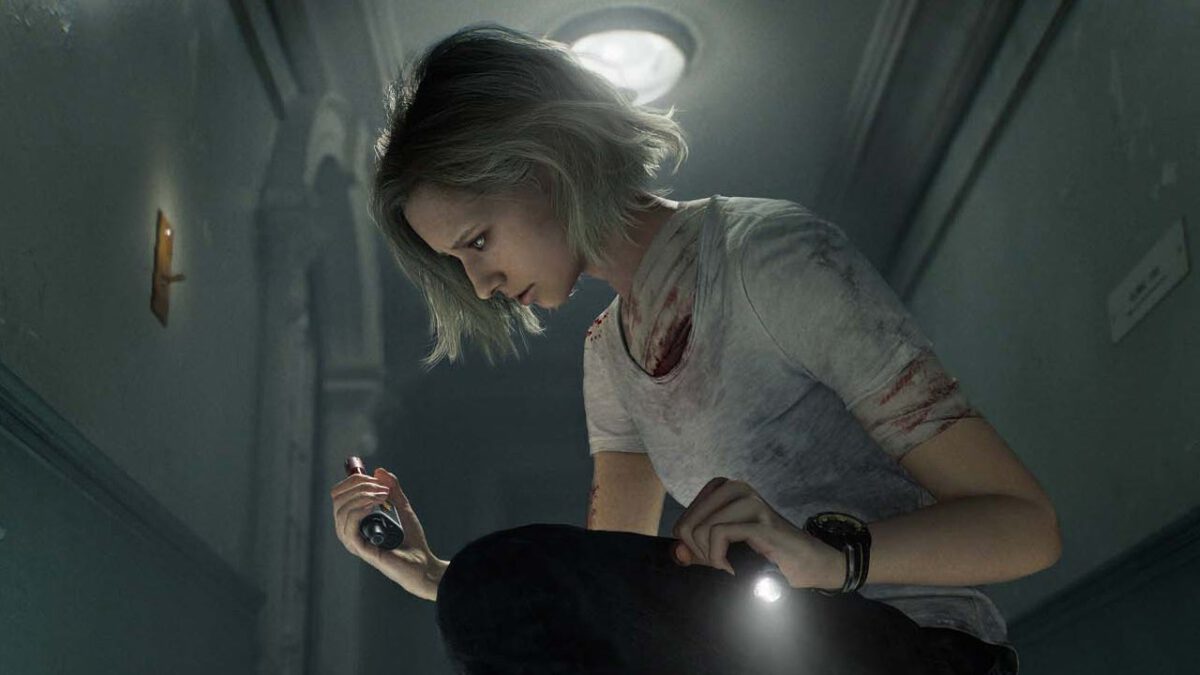
The care center also shows huge gaps between the ray traced and the non-ray traced versions of the game. When you get to this spooky looking hallway, with its flickering lights, look at how the lighting behaves. With the non-RT mode, the light cuts off almost like it hits a hard boundary. However, with ray tracing, the ray traced global illumination takes the light from the lamp at the end of the corridor and makes it extend much more naturally down the hallway, tapering off the further away it gets from the source.

You can also see along the edges, where the pictures on the wall are in complete darkness just a few feet into the hallway, where the light bounces more naturally when ray tracing is enabled. It’s a small touch, but it really does do a lot to make the game a bit more atmospheric.

Though, to be fair, even without ray tracing, I was much more worried about what was lurking around the next corner than I was about slightly unrealistic lighting.

At the end of the day, the same age-old advice applies to Resident Evil Requiem. If you have a high refresh display and you like the extra visual smoothness that comes from a high frame rate, turn ray tracing off if you have a PS5 Pro. The game looks great regardless, and going up to 100-ish fps will make a huge difference when you’re panicking.

But if you don’t have a high-refresh display, or if you just like having your games look as good as possible, go ahead and turn ray tracing on. Yeah, you’ll take a hit to performance, but it still gets a solid 60 fps on PS5 Pro and it looks incredible.

Jackie Thomas is the Hardware and Buying Guides Editor at IGN and the PC components queen. You can follow her @Jackiecobra

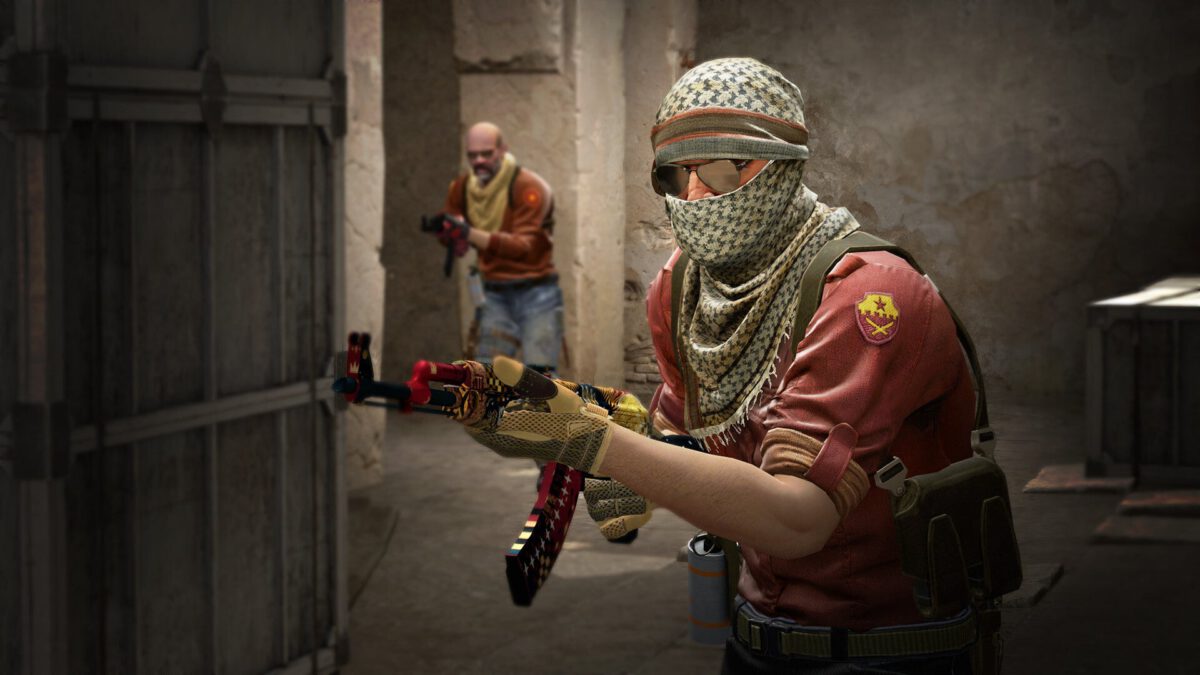
Counter-Strike: Global Offensive Has Its Own Page on Steam Again — but There’s a Catch

Counter-Strike: Global Offensive — known to most as CS:GO — is back on Steam in its own right… but only if you know where to look.

Counter-Strike 2 regularly tops Steam’s Most Played games list (for example, it hit a peak of 1.3 million players just in the last 24 hours alone). Its predecessor, however, was well-loved, too, yet it was effectively nuked when its home on Steam was replaced as Counter-Strike 2 dropped in 2023. That meant that if you’d wanted to play CS:GO before this update, you would’ve had to dig into the game’s legacy branch via Steam and access it from there.

A stinging caveat is that the servers have not been resurrected, nor is there any matchmaking, which means you can only play against the bots available to you via Counter-Strike 2’s beta branch. But the fact it’s been given its own store page could — maybe? — be a sign that those kinds of things may eventually come back to life. (I wouldn’t hold your breath, though. Just in case!)

That hasn’t stopped thousands of players from jumping into the free-to-play shooter, though. At the time of this article’s publication, it had 44,058 concurrent players on Steam — pretty impressive stuff for a 14-year-old game.

Interestingly, though, CS:GO won’t pop up in a search for you — as the store page cautions, “at the request of the publisher, Counter-Strike: Global Offensive is unlisted on the Steam store and will not appear in search.” This means you’ll need the direct link to access and download it.

Meanwhile, the attorney general of New York, Letitia James, is suing Valve, alleging the platform illegally promotes gambling to children. The AG’s office announced last week that an investigation “found that Valve’s video games, including Counter-Strike 2, Team Fortress 2, and Dota 2, enable gambling by enticing users to pay for the chance to win a rare virtual item of significant monetary value.”

Vikki Blake is a reporter for IGN, as well as a critic, columnist, and consultant with 15+ years experience working with some of the world’s biggest gaming sites and publications. She’s also a Guardian, Spartan, Silent Hillian, Legend, and perpetually High Chaos. Find her at BlueSky.

Ahead of Myrient’s RAM crisis-linked demise, volunteers are working to archive its entire collection

Earlier this week, the operator of ROM distribution site and self-described “video game preservation service” Myrient announced plans to shut it down as of the end of this month. They advised folks to download any files from the collection that said folks were keen to hold onto ahead of the closure. A group of volunteers have decided to take that to another level, working together to archive all of Myrient’s files so they can be preserved for posterity.

Read more

Trump Administration Debating Allowing Chinese Company Tencent to Keep Its Stakes in U.S. Gaming Companies Such as Fortnite Maker Epic and League Dev Riot

President Trump’s administration is currently debating whether to allow Chinese megacorp Tencent’s stakes in major U.S. companies such as Fortnite maker Epic Games and League of Legends developer Riot Games to continue.

The FT reports that “top officials” have met to assess the security risk of Tencent’s investments in numerous U.S. and Finnish gaming firms ahead of President Trump’s meeting with Chinese President Xi Jinping next month.

Tencent has been acquiring western game companies for well over a decade now, but its most high-profile investments include a 28% stake in Epic Games, which is based in North Calorina, and the wholly owned Riot Games, which is based in Los Angeles. It also wholly owns Finnish company Supercell, which runs mobile mega hit Clash of Clans, and recently invested in a new Ubisoft business following the Assassin’s Creed maker’s financial troubles.

Sources said that Tencent was negotiating with the U.S. administration’s Committee on Foreign Investment (Cfius) last summer to help ease these security concerns, and, as far back as President Trump’s first term, was assessing whether Tencent’s investments could jeopardize the data of millions of American players. Cifus is similarly concerned about the company’s acquisition of Finnish firm Supercell, which has a huge player base in the U.S.

In January last year, the U.S. Department of Defense classified Tencent as a Chinese military company. At the time, Tencent insisted it was all a mistake. The upshot of this latest development is that the Trump administration may force Tencent to divest the gaming companies, or force it to create data protections it’s satisfied with. Neither the White House nor Tencent or Epic responded to requests for comment.

Photo by Ying Tang/NurPhoto via Getty Images.

Vikki Blake is a reporter for IGN, as well as a critic, columnist, and consultant with 15+ years experience working with some of the world’s biggest gaming sites and publications. She’s also a Guardian, Spartan, Silent Hillian, Legend, and perpetually High Chaos. Find her at BlueSky.

The Division 2’s new Realism Mode chops back the HUD, ammo and health regen, and is free for a month

It seems like a million years have passed since the release of Tom Clancy’s The Division 2, the squalid shooter-looter set in banged-up Washington D.C. In fact, it’s only been seven. Which is quite a lot of years, in fairness, but that period also spans a lot of upheaval – the Covid pandemic, Trump’s re-election, the exploding popularity of generative AI, the onset of chronic live service apathy, the lingering undeath of NFTs, and the literal invasion of Washington D.C. by the National Guard.

Both The Division 2’s original looting mechanics and its 100% apolitical regime change storyline now feel to me like the products of a different universe, though Ubisoft have been updating the game and releasing new stuff for it throughout. Their latest addition is a Realism Mode, exclusively available through the existing Warlords of New York expansion, which will itself be freely available to all players until 2nd April.

Read more

Resident Evil Requiem Has Already Sold Over 5 Million Copies

Performing with Grace.

Capcom has announced that Resident Evil Requiem has already sold over 5 million copies since its release on 27th February 2026 (thanks, Eurogamer). Yeah, that’s 5 million in less than a week, folks.

We’re not sure what the platform split is for this running total, but with the combined release of the standalone game and the Generation Pack bundle, we imagine the Switch 2 has seen its fair share of sales. Regardless, this is a stellar start for the game, and a true indication that audience appetite for highly curated, single-player experiences is still extremely high.

Read the full article on nintendolife.com

Resident Evil Reqiuem Is a Kick-Ass Leon Kennedy Legacy Sequel

Great news: Resident Evil Requiem absolutely kicks ass. While it was initially advertised as a survival horror vehicle for new protagonist Grace Ashcroft, it turns out Requiem is equally a reunion with the series’ fan favorite hero, Leon S. Kennedy. Despite showing up in several remakes recently, Leon hasn’t had a genuinely new adventure since Resident Evil 6. That was 14 years ago! Requiem brings us a Leon who’s still that campy, quippy, tough-as-nails legend we’ve always loved, but now he’s older, wiser, and carrying a bit more baggage with him. This kind of return is pretty uncommon in video games, but take a look at the screenings at your local multiplex and you’ll see it’s happening all the time now in movies. Old heroes from old franchises coming back to prove that a few extra wrinkles can’t stop you from kicking ass. That’s exactly what Resident Evil Requiem has done. It feels like a Hollywood blockbuster legacy sequel for one of the coolest video game characters of all time.

You could easily make the argument that Resident Evil 4 is the greatest video game ever created, and diehard fans of Capcom’s game changer have wanted a reunion with Leon for decades. His short part in Resident Evil 6 simply wasn’t enough, and while 2023’s Resident Evil 4 remake was incredible, it was ultimately a retelling of a story we all knew extremely well. For years, we’ve been left wondering if we’d ever get anything like Leon’s gory Spanish vacation again. At least until now: Resident Evil Requiem is a worthy successor to Resident Evil 4. But more than that, it gives us a fresh take on Leon that’s more interesting than many sequels offer.

Despite being a medium that has been going strong for over fifty years now, video games rarely let their protagonists grow older. Mascot characters like Super Mario and Sonic the Hedgehog are basically the same age now as they were when they were first introduced in ‘80s and ‘90s. There are a few exceptions, of course. Uncharted’s Nathan Drake had aged slightly by the time we said goodbye to him in 2016, and Tomb Raider’s Lara Croft has jumped around to various stages of her 20s throughout her numerous sequels and reboots. But most video game characters live in an endless time loop, destined to stay encased in amber at the same age forever, like Bart Simpson and his fellow classmates being stuck in fourth grade for decades.

The Resident Evil franchise is different; it’s one of the few long-running video game series that actually allows its characters to experience the passage of time, albeit with all sorts of silly B-movie plot armor, continuity leaps, and other various nonsensical story beats to help carry them along the way. That’s why seeing a gruffer, more weathered Leon S. Kennedy’s return in Resident Evil Requiem feels so special – it’s something we don’t get to see very often in video game form. Games are largely power fantasies, after all, and seeing an older Super Mario clutch his knees after a triple jump, or a hunched over Sonic the Hedgehog gasp for breath in the middle of a half pipe run, would be way less cool and way more of a stark reminder of our weary, fragile lives than just seeing those guys at their peak age forever.

On the other hand, Hollywood loves to bring back older versions of classic movie characters for a big legacy sequel, partly because it’s fun to check in on old friends you haven’t seen in a while, but mostly because actual human actors – unlike video game characters – get older as time passes. For example, think about Harrison Ford in Star Wars: The Force Awakens portraying an older, greyer Han Solo. Or Harrison Ford in The Dial of Destiny portraying an older, greyer Indiana Jones. Or Harrison Ford in Blade Runner 2049 portraying an older, greyer Rick Deckard. (I swear I have more examples besides Harrison Ford.) Do all of these movies need to exist? Definitely not. But when a legacy sequel works, they feel like a great reunion with someone we haven’t seen in a while, and sometimes, even a perfect final sendoff to a character we’ve cherished our entire lives.

When you’re put in control of Leon, it really does feel like a return to the character’s best days.

We may have technically caught up with Leon recently, thanks to the glorious Resident Evil 2 and 4 remakes, but those games take place in 1998 and 2004, respectively. The Resident Evil timeline progresses in real time, though, so in Requiem, set in 2026, Leon is actually much older now, and he’s got the wrinkles and mannerisms to prove it. He’s slightly less likely to crack a corny one liner or silly pun after a big, violent encounter (but don’t worry, the man still has some jokes here and there.)

Requiem balances Leon’s dad jokes (or should that be “hot uncle” jokes?) with some grit and gravitas. He is reminded of his regrets and past failings as he revisits the horrors that unfolded in his early days as a cop in Raccoon City, with its current bombed-out streets, dilapidated police station, and gun shop all trudging up the grief and remorse from his first big missions. But while this offers a darker side to Leon’s story, we don’t really get a deep look into his personal life, which definitely works in both the character’s and our favor. Going decades without seeing Han Solo, just to find out he ended up being a deadbeat dad who’d resorted to once again dealing with low life gangsters and petty crimes in The Force Awakens was a pretty depressing get together in hindsight – like running in to the older kid from your town that you grew up idolizing and finding out he still lives with his mom and he mostly just sells cigarettes to teenagers behind a gas station. We didn’t need that downer with Han and I’m glad we don’t get that with Leon, a character who in Requiem is largely focused on a new assignment with nearly all of the passion, intensity, and wit we expect from him. He’s struggling with his memories of Raccoon City because he’s back in it, not missing his daughter’s dance recital because he’s pounding shots at the bar.

What’s important, though, and an experience unique to the video game medium, is that Requiem’s Leon still feels like he did in Resident Evil 4, despite being much older. Mechanically, he moves and controls just like he did in RE4’s 2023 remake, just with a few extra tricks up his sleeve thanks to the benefit of age and experience. There were so many little moments in Requiem where I thought to myself “I cannot believe I’m getting more Resident Evil 4 right now.” It wasn’t that I thought I’d never ever play anything like that again in this franchise, it’s just that after RE7 and Village, I truly had no idea where things would go next. And while Requiem certainly does build on the survival horror elements of those games, when you’re put in control of Leon, it really does feel like a return to the character’s best days.

So many of Leon’s sections in Requiem work as callbacks to things I loved about Resident Evil 4, but he approaches them with the added benefit of the wisdom and experience that comes with getting older. Remember the chainsaw wielding lunatics from the village? Well, there’s new ones now, and this time you can shoot those chainsaws out of their hands and use them to tear a room full of zombies apart. Remember the high speed jetski escape sequence? There’s a new one now that’s an infinitely cooler set piece and adds enemies to the mix.

Not everything here is an improvement over Leon’s most iconic mission, of course. Requiem doesn’t have a lovably weird merchant character, or shiny costume jewelry dangling from its corridor ceilings or inexplicably hiding in the bellies of its creepiest basement creatures. Resident Evil 4 is, after all, one of those once in a lifetime video games where a team of bold creative geniuses were given several years and a blank slate to create a sprawling, cinematic single player game that reinvented a beloved franchise. We’ll almost certainly never get anything like it on that scale again. But when Requiem comes close to hitting some of those same highs, it’s a fantastic feeling.

But the one thing a truly great legacy sequel recognizes – and one that Requiem very much understands – is that our heroes don’t live forever and, frankly, it’s selfish of us to expect them to. The people we look up to eventually get old and die, and leave us with just memories to remember them by. Yes, even the ones that can somersault over zombies or dive roll through a second-story glass window and land on both feet unphased. But the greatest heroes don’t just leave their legacy behind, they impart their wisdom and experience on the next generation in the hope that they will grow to become as great, or even greater, than they ever were. That’s how legacy sequels bring together their original and new cast members, and we see that in action with Leon and Grace, a skittish FBI agent who enters into Requiem’s instantly threatening story with fear and trepidation.

Grace begins her journey quite literally stumbling around in the darkness, holding a crude knife in a shaky hand and struggling to survive. But by teaming up with Leon while also confronting her own past traumas, she slowly becomes a strong, resilient, fully capable star of her own. She might never go full blown action hero like her mentor, and that’s okay, but it’s exciting to think her story may just be getting started. What we see between her and Leon is a torch passing ritual, a necessary chapter in any ongoing story where characters are allowed to age naturally, reach the end of their tale, and eventually even die.

That’s not to say I would turn down any more adventures with our old friend Leon in the future, of course. I love the guy, and I think there’s still a lot of gas left in his tank. I just don’t know if I want to play a video game where he’s 80 years old and I need to upgrade his hip replacement every time he attempts a spin kick. Then again, for all of the ways Requiem handles an aging legend gracefully, Resident Evil has long been a franchise where body mutating mega viruses and super serums allow once-human characters to return bigger and stronger than ever, even after getting axed apart or blown to smithereens with nukes. So hey, maybe next time Leon’s in town he’ll be looking a little less like a hot uncle.

But until they jump that zombie shark (and this series literally has one of those, named Neptune) I’ll gladly take more Grace and Leon games in the future. And seeing how well Capcom handled an older Leon opens up all kinds of possibilities for other classic Resident Evil characters to return with a few more grey hairs. After all, Resident Evil Requiem never makes any mention of Claire Redfield (outside of a reference on a charm) so here’s hoping she shows up in some DLC or even gets to star in the next mainline game. Either way, it’s great to see a series I’ve loved for so long find so many great ways to stay alive and thriving while so many other classic franchises shamble along long past their expiration dates, like the rotting, festering zombies that Leon – and now Grace – are so great at defeating.

Nintendo Announces 3 Retro Mario Games Returning for Mario Day

Next week’s annual celebration of Super Mario will be marked by the return of three retro games via Nintendo Switch Online.

Nintendo will add two more Virtual Console titles and a popular Game Boy Advance classic to its subscription service on March 10, otherwise known as Mario Day (because its date is MAR10).

The recently-launched Nintendo Switch Online Virtual Console range will get Mario Tennis and Mario Clash, both released in 1995, while its Game Boy Advance catalog will add 2004’s Mario vs. Donkey Kong. You will, however, need the Switch Online’s pricier Expansion Pack tier to access the games.

If you like peering into a peripheral and batting away balls, Mario Tennis is a fairly standard sport experience that happens to feature Nintendo’s mascot and other Mushroom Kingdom residents on the court. Mario Clash, meanwhile, is set within the a series of underground pipes and lets you go bowling with Koopa Troopa shells.

Of the three, Mario vs. Donkey Kong is the most interesting. A spiritual successor to the original Donkey Kong, this puzzle platformer was successful enough that it spawned a whole spinoff series, and a full Switch remake that launched in 2024. Here, you can see where that all started.

Nintendo has not yet announced any other celebrations to mark Mario Day, though fans are hoping we hear more from the company soon following a recent third-party Partner Direct and this week’s Indie World broadcast. The company has often held a full Nintendo Direct in March, ahead of the financial year’s end. Maybe we’ll hear more about that next week too.

Tom Phillips is IGN’s News Editor. You can reach Tom at tom_phillips@ign.com or find him on Bluesky @tomphillipseg.bsky.social

No Fallout New Vegas remaster teases here, Iron Galaxy say, we’re just really enthusiastic about meetings

Have you ever noticed your next company-wide meeting’s due and thought the following: ‘Oh, we should post an image prominently featuring a screen from a game rumoured to potentially be getting the remake or remaster treatment, but solely to illustrate how much we love meetings’? Well, Iron Galaxy Studios – co-developers of Skyrim‘s Switch port and support studio on Fallout 76 – say was what happened late last week. The studio say their social media posts featuring Fallout: New Vegas‘ ‘Please Stand By’ screen have “nothing to do with anything Fallout being worked on”.

Read more